
Author:
Matt Symonds
Like what you read? Make us a preferred source on Google.
Every business school has a professor who will happily step away from their research for a call from the Financial Times or the Wall Street Journal, and for almost nobody else. Other requests receive a gracious note about grant deadlines. I say this with affection: research time is precious, and for decades a quote in one of those two papers was invaluable visibility.
The programme director has the opposite problem. They know exactly who they need to reach: an engineer in Colombia considering a one-year MBA, or finance graduates in Bucharest looking at a master’s in Europe. The FT reaches some of them. Others are scrolling something closer to home.
More of those candidates now ask ChatGPT, Claude or Google’s AI Mode which school is strongest for fintech, or who teaches family business best. Those answers draw on a far wider pool of sources than the FT and WSJ.
Here are six media coverage opportunities schools might turn down, and why they are worth a second look.
Reaching international candidates where they read
An interview with a respected Romanian business site, or the careers pages of a Colombian magazine rarely gets a professor excited. It should get the programme director excited. These outlets sit in a candidate’s news feed, often in their first language, next to the stories they actually read.
They matter for AI search too. A Temso study of more than seven million AI citations found that when people ask Google’s AI Overviews a question in Spanish, around 83% of the sources cited are in Spanish. Yet in higher education, nearly half the sources cited for non-English questions were in English. A school that appears in local-language coverage is filling a gap, not fighting every global rival for space.
It doesn’t have to be hard. A professor’s view on inflation, or a programme director’s advice on scholarships, can be written once in English, then translated and adapted for each market. One good interview can become the spark for more.
Newsletters and roundups with big AI visibility
Not every interview becomes a feature. Sometimes a professor’s 20 minutes ends up as two lines in a specialist newsletter, or a single quote in a piece on “ten academics to follow on AI”. It’s tempting to call that a poor return.
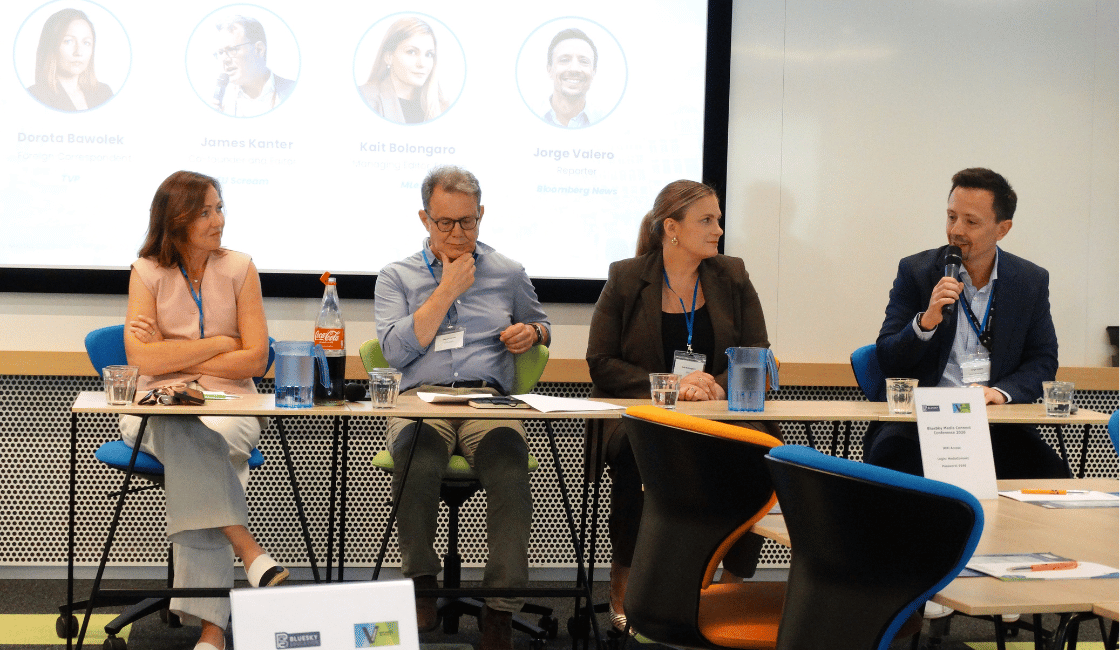
I would argue the opposite. Newsletter readers have opted in, and many newsletters live on as open web pages that can be found and cited later. At the BlueSky Media Connect Conferences, editors from the FT, NYTimes and many other leading media confirm that newsletters get the biggest readership beyond the home page.
Roundups carry even more weight. In cloro’s monitoring of AI answers, third-party listicles and comparisons appeared in 43% of responses, far more than any brand’s own content. When a candidate asks which schools lead on sustainability, this is the format the answer is built from.
There is a relationship benefit too. The journalist who got a generous, useful answer this month is far more likely to call again for future stories.
Niche podcasts your audience actually listen to
For a programme director, 1,000 listeners is not a small audience if they are the right 1,000. Shows run by admissions consultants, test prep providers, student clubs or alumni reach people who are already weighing applications, and who chose to spend 40 minutes on the subject. Few advertising campaigns buy that kind of attention.
The same goes for faculty. A professor explaining their supply chain research on a specialist show is talking to practitioners who care. And because most podcasts now publish transcripts and show notes, that hour becomes searchable text that AI tools can read long after the episode goes live.
The explainer on a YouTube channel
YouTube has become a source behind AI answers. Data from Bluefish, reported by Adweek, found YouTube cited in 16% of AI answers over the six months to January 2026, against 10% for Reddit. Cloro’s tracking shows its share still rising through the summer.
The encouraging part is that lots of views isn’t what it’s all about. One review of the research notes that many AI-cited videos had fewer than 1,000 views. What the tools want is clear explanation and a transcript they can read. So when a modest channel asks your finance professor to explain private credit or bitcoin, or invites your programme director to talk through GMAT versus GRE, say yes. Then ask for a descriptive title, chapters and the school’s name in the description.
Thought leadership under your own name
Most Deans, professors and programme directors already have a LinkedIn audience, and the platform featured heavily in AI search earlier this year. A Semrush study of prompts run in January and February 2026 placed it second among cited domains, though of course it is one channel among many.
It is voice that makes the difference. Long-form articles made up 59% of LinkedIn citations in cloro’s data, company pages just 4%. Meltwater found three quarters of cited LinkedIn content came from individuals, and more than half from people with under 10,000 followers. A dean’s thoughtful article, or a career services director’s candid piece on what the current job market really looks for is therefore likely to do some heavy lifting.
The AI search asset you already own
The least glamorous opportunity sits on your own website. Cloro found a brand’s own site cited in nearly 20% of AI answers. Faculty profiles that list a PhD and a paper from 2017, or programme pages written in admissions jargon, are a missed chance.
Clear, current pages that explain in plain English what each professor works on and who each programme is for give AI tools something accurate to quote. Translated versions for your priority markets give them something to quote in those languages too.
Why business schools should say yes more often
None of this makes the FT or WSJ less important. A story in a report or this week’s market coverage still opens doors that a podcast perhaps never will. But visibility is now built from many small, credible appearances, each adding to the picture an AI tool draws of your school and its people.
So the next time a professor waves away a request from a business site in Lisbon, it may be worth a gentle word, or a nudge to the programme director, who will probably say yes before you finish the sentence. The candidate reading that interview might ask ChatGPT about your MBA next week.
If you would like help deciding which opportunities are worth the time of your faculty and staff, contact BlueSky Education.

-1-1.jpeg?width=200&height=179&name=Matt%20AMBA%20Global%20Conference%20(1)-1-1.jpeg)
Considered one of the foremost experts in business and higher education, Matt has co-founded some of the most respected and successful business school and university initiatives and media companies of the last 25 years.
He launched BlueSky Education after co-founding and directing QS Quacquarelli Symonds (the S of QS), publishers of the QS World University Rankings and organisers of global MBA, Masters and undergraduate events. Responsible for many of the global media partnerships with Bloomberg, CNN and leading national publications across North America, Europe and Asia it was then a natural next step to build an internationally-focused communications and consulting agency dedicated to business and higher education.
Share:


Share your thoughts
Free Guide
We've got you covered with tips and expert advice on best practices across each platform, examples of what's working for your competitors and ideas on how to update your social media strategy.
Get It Now